Multi scale wavelet thresholding
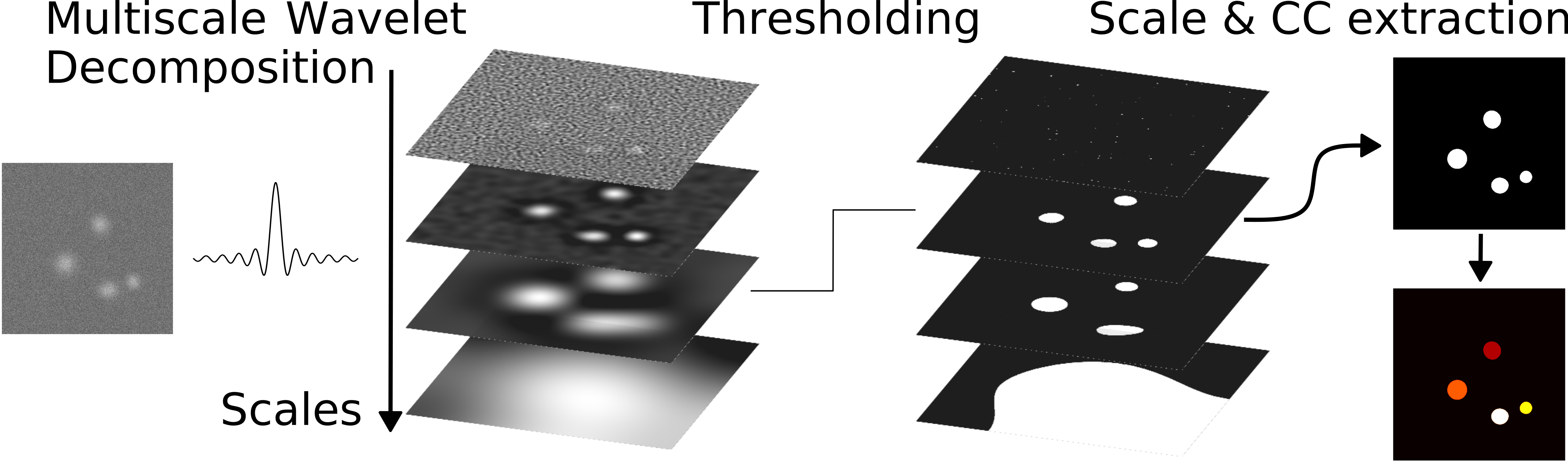
- class byotrack.implementation.detector.wavelet.B3SplineUWT(level: int = 3)
Bases:
ModuleUndecimated Wavelet Transform with B3Spline for 2D images
Also called A trous Wavelet Transform.
Let J be the level of the UWD. Let c_0 be the original image. It computes successively dilated convolution of it.
c_j = h_j * c_{j-1}, 1 le j le J w_j = c_{j-1} - c_{j}, 1 le j le J
Where h_j is the filter at scale j which is the original filter h_1 dilated with 2^{j - 1} 0 between each coefficient and h_1 = [1/16, 1/4, 3/8, 1/4, 1/16].
The parameters returned are [w_1, w_2, …, w_J, c_J]. The original image is easily reconstructed from the parameters with c_0 = c_J + sum_j w_j
Boundaries issues are handled using mirror padding.
- forward(x: Tensor) Tensor
Compute the parameters of the UWD
- Parameters:
x (torch.Tensor) – Input images without channel dimension Shape: (B, H, W)
- Returns:
- Parameters [w_1, …, w_J, c_J]
Shape: (B, J + 1, H, W)
- Return type:
torch.Tensor
- class byotrack.implementation.detector.wavelet.B3SplineUWTApprox(level=3)
Bases:
ModuleApproximation of Undecimated Wavelet Transform with B3Spline for 2D images
Split the 2D convolution in two 1D convolution first alongside the rows then the columns.
After some analysis this implementation is slower than the first one… even though it should be faster.
- forward(x: Tensor) Tensor
Compute the parameters of the UWD
XXX: Batchsize != 1 is not supported yet
- Parameters:
x (torch.Tensor) – Input images without channel dimension Shape: B x H x W
- Returns:
- Parameters [w_1, …, w_J, c_J]
Shape: B x J + 1 x H x W
- Return type:
torch.Tensor
- class byotrack.implementation.detector.wavelet.WaveletDetector(scale=2, k=3.0, min_area=10.0, device: device | None = None, **kwargs)
Bases:
BatchDetectorDetection of bright spots using B3SplineUWT
Following paper from Olivo-Marin, J.C. Extraction of spots in biological images using multiscale products. Pattern Recognit. 35, 1989-1996
The algorithm is in 4 steps:
UWT decomposition
Scale selection
Noise filtering
Connected components extraction
The multi scales behavior (choosing multiple scales) was implemented but we decided to drop it. It adds complexity without real advantages from our experience.
The same algorithm is implemented in Icy Software (SpotDetector). The main differences are:
2d wavelets (rather than 2 times one dimensional wavelets). It was designed to improve computations, but with torch no gain in time is observed. (Can be switch with FOLLOW_ICY)
Thresholding -> We follow the original paper.
- scale
Scale of the wavelet coefficients used. With small scales, the detector focus on smaller objects.
- Type:
- k
Noise threshold. Following the paper, the wavelet coefficients are filtered if coef le k sigma. (The higher the less spots you retrieve)
- Type:
- device
Device on which run the B3SplineUWT Default to cpu
- Type:
torch.device
- b3swt
Undecimated wavelet transform
- Type:
- \*\*kwargs
Additional arguments for BatchDetector (batch_size, add_true_frames)
Warning: The connected components used (opencv) yields segfault with too many components…
- detect(batch: ndarray) List[Detections]
Apply the detection on a batch of frames
The frame id of each detections is set afterward by the BatchDetector run method
- Parameters:
batch (np.ndarray) – Batch of video frames Shape: (B, H, W, C)
- Returns:
Detections for each given frame
- Return type:
Collection[byotrack.Detections]
- compute_threshold(coefficients: Tensor) Tensor
Compute threshold for the UWT coefficients
Note: One could use MAD approx of sigma rather than std (or Icy implem) but it’s almost equivalent (And k is a parameter to tune so it truly is)
- Parameters:
coefficients (torch.Tensor) – Coefficients of the UWT Shape: (…, H, W)
- Returns:
- Threshold for each scale
Shape: (…, 1, 1)
- Return type:
torch.Tensor